
The Story of Skiing in the Petoskey Area
November 19, 2026
Michigan is often regarded as the American birthplace of organized skiing thanks to Scandinavian immigrants who brought the sport to the hills of the Upper Peninsula in the 1880s. Winter recreation has been an integral part of the Petoskey area history for nearly a century, thanks to the abundance of “lake effect” snow which blankets the area slopes—averaging about 140 inches annually, according to the National Weather Service.
In the early 1920s, mid-winter carnivals began popping up in Petoskey, Harbor Springs and Charlevoix, with skating, snowshoeing, tobogganing and skiing contests offering prizes for top competitors.
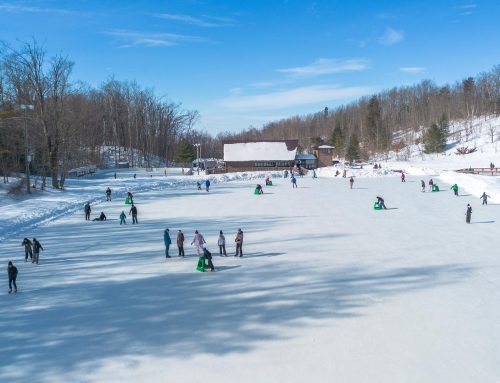
The first such event in Petoskey took place downtown and by 1928 it had moved to what is now known as the Winter Sports Park (previously the site of Swan Lake City Park, Petoskey City Park and Petoskey City Zoo). The park included a quarter-mile toboggan slide, a 400-square-foot ice rink, and a ski hill with a tow rope staffed by the Kiwanis.
Petoskey was soon considered “Michigan’s Winter Sports Capital” with “snow trains” from Chicago and Grand Rapids bringing hundreds of winter sports enthusiasts to town to watch and participate in a variety of outdoor activities.
Ski resorts soon followed and by the mid-twentieth century, Michigan ranked #2 in the country for the number of these destination properties throughout the state—including several notable pioneering operations in the Petoskey Area.
Boyne Mountain
Everett Kircher, John Norton and Jim Christianson founded Boyne Mountain in Boyne Falls after purchasing the land from a well-known and respected local resident named William Pearson—a former teacher, sheriff, Charlevoix County register of deeds, chief forest fire warden in Lansing and Michigan legislator having served in both the House of Representatives and the State Senate.
“John, Jim and I each anted up $5,000 seed money we thought would be needed to buy the property,” according to Kircher’s 1998 biography. “When we told Pierson why we wanted it, he said, ‘Anybody damn fool enough to want to build a ski hill, well…I’ll give you the property.’”
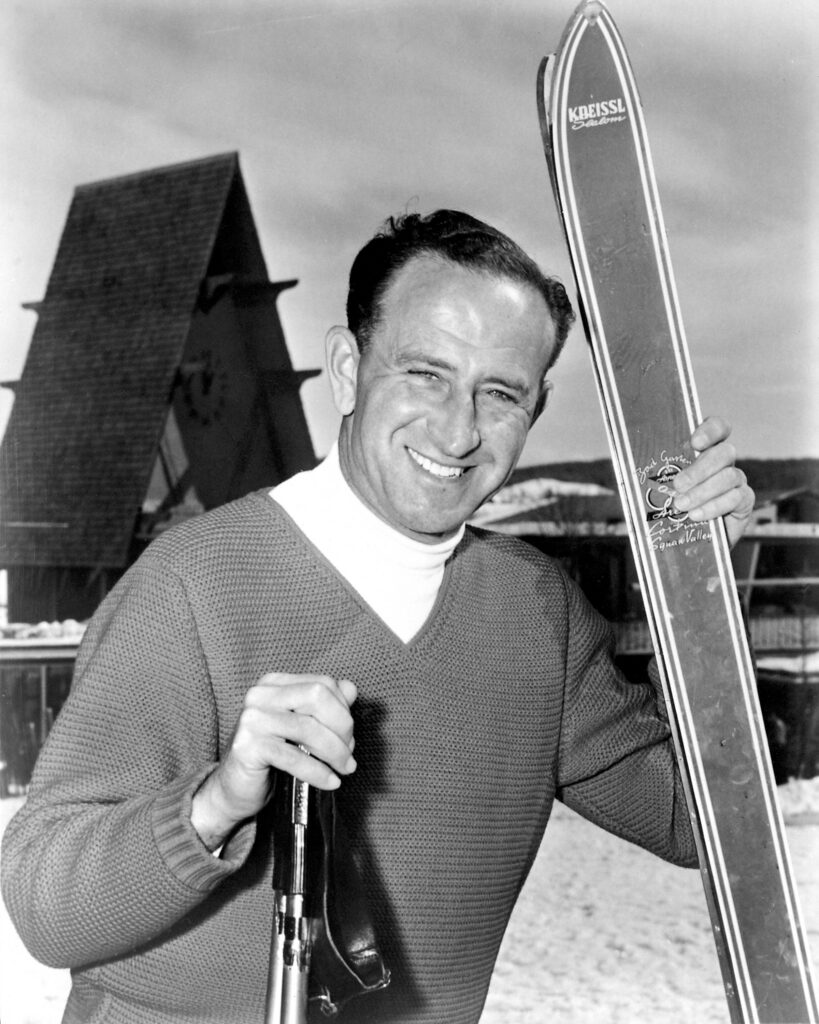
Photo courtesy of Boyne Mountain Resort
Little did Pierson know how that simple transaction would snowball into a lasting legacy with the formation of Boyne Ski Lodge, Inc., in 1947.
The first public mention of the project appeared in the June 19, 1948, issue of the Petoskey News Review under the headline “New Winter Resort is Started in Boyne Falls” noting that the developers withheld public announcement until all the property (640 acres total) could be leased. “Representing a group of Michigan skiers, the trio sought to find the best skiing site in the state and develop it into a resort. After an extensive survey of conservation department contour maps they settled on the Boyne Falls location.” A projected opening date was set for the week of Christmas, just six months down the road.
Throughout the summer, members of the Detroit American Youth Hostel helped clear the land by hand for four major ski runs—no bulldozers were used, according to the resort’s website. The Grand Rapids Press on June 18, 1948, noted “crews, armed with power saws, will start ‘logging operations Monday on the slopes of Mays hill.’”
Heading into the fall, construction began on a 40 x 60 two-story chalet-style clubhouse. By mid-September, news broke that Boyne would install the first chairlift in the Midwest—the 1936 Dollar Mountain single chairlift from Sun Valley Resort in Idaho, which Kircher had dismantled and shipped by rail car to northern Michigan. Work progressed at a rapid pace and as projected, the resort opened on Sunday, December 26 and instantly attracted skiers from throughout the central United States and as far away as New York and Connecticut. Victor Gottschalk, an internationally known ski instructor who had reportedly taught many movie actresses to ski at Sun Valley, was hired to direct the Boyne ski school.
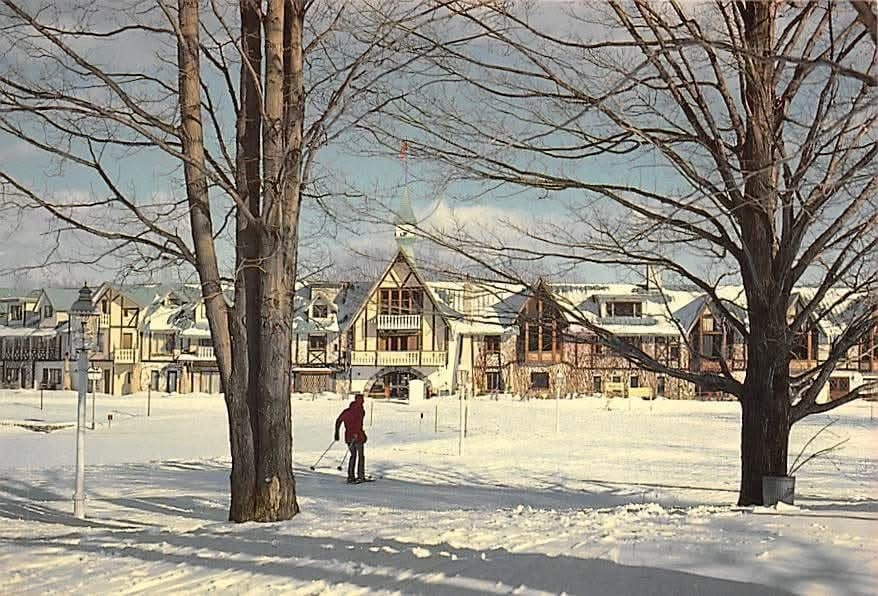
Photo credit: Michigan Ski Area History on Facebook
Boyne Mountain Lodge was formally dedicated on Saturday, January 8, 1949, according to the Grand Rapids Press. William Pearson gave a speech at the base of the hill that he once owned, which was broadcast live by Detroit-based WJR radio. State Highway Commissioner Charles M. Zeigler also addressed the crowd.
“In the afternoon, following sight-seeing tours over the seven slopes, a dedication down-hill race will be staged at 2 on the 1,800-foot main slope. Visiting professionals from other Michigan ski resorts and experienced skiers will take part in the race,” the January 6, 1949, Press reported.
That evening, a banquet was held at the Hotel Dilworth in Boyne City, with special guests Louis D. MacGregor, president of the Michigan United Conservation Clubs; Chester Wells and Aurey Strohpaul of the Western Michigan Tourist and Resort Association; and Frank Davis of the East Michigan Tourist and Resort Association.
Not reliant on Mother Nature to provide the necessary snow for a successful season, Kircher began looking for innovative ways to increase the accumulation on the slopes, becoming one of the early adopters of artificial snowmaking.
In 1964, the Meadows chairlift became the first quad in the world providing more efficient access to the top of the hill for skiers (it was replaced in 2008 with a Doppelmayr quad, the only one of its kind in the Midwest). America’s first six-seat, high-speed chairlift—Mountain Express—was unveiled in 1992. In 2022, the state’s first Doppelmayr D-Line high-speed eight-person lift, coined the D8, was installed to replace Disciples I and II, transforming rider capacity in the Disciple’s Ridge area.
Over the years, Boyne Mountain continued to enhance its facilities, adding family-friendly lodging, outdoor pools, restaurants, activities and notable events. Today, the Mountain’s winter offerings include 415 skiable acres and 500 feet of vertical lift, 65 downhill runs, five terrain parks, 10 chairlifts, 35km of cross-country ski trails, 5km of dedicated snowshoe trails, a famed 1,200-foot elevated SkyBridge, a 220-room Mountain Grand Lodge & Spa, an indoor waterpark and more (with no end in sight).
The Highlands
During the Great Depression, Harbor Springs dentist Dr. Frank Graham accumulated approximately 600 acres of land to serve as his family’s hobby Pioneer Farm northeast of Harbor Springs in southern Pleasantview Township. Frank was a well-connected resident of the community, having served as mayor and school board president. In the mid-1950s, a handful of local businessmen rallied to develop a small ski operation near his farm called Harbor Highlands.
“Jan. 2 is the date set by the Harbor Highlands Ski Club for the dedication of its new ski hill at Emmet Heights,” according to a December 22, 1955, article in the Grand Rapids Press. “President Tom Graham [Frank Graham’s son] reported a bulldozer has completed clearing the hill of trees and shrubs. The tow machinery has been placed at the hill’s summit, the parking lot has been completed and poles and tow rope will be placed this week. There is 12 inches of snow on the slope. Graham announced that beginners ski classes will be held each Saturday morning with Edward Beer, local high school teacher, and ski expert, in charge. Tentative plans are for the hill to be open on Tuesdays, Thursdays, Saturdays and Sundays.”
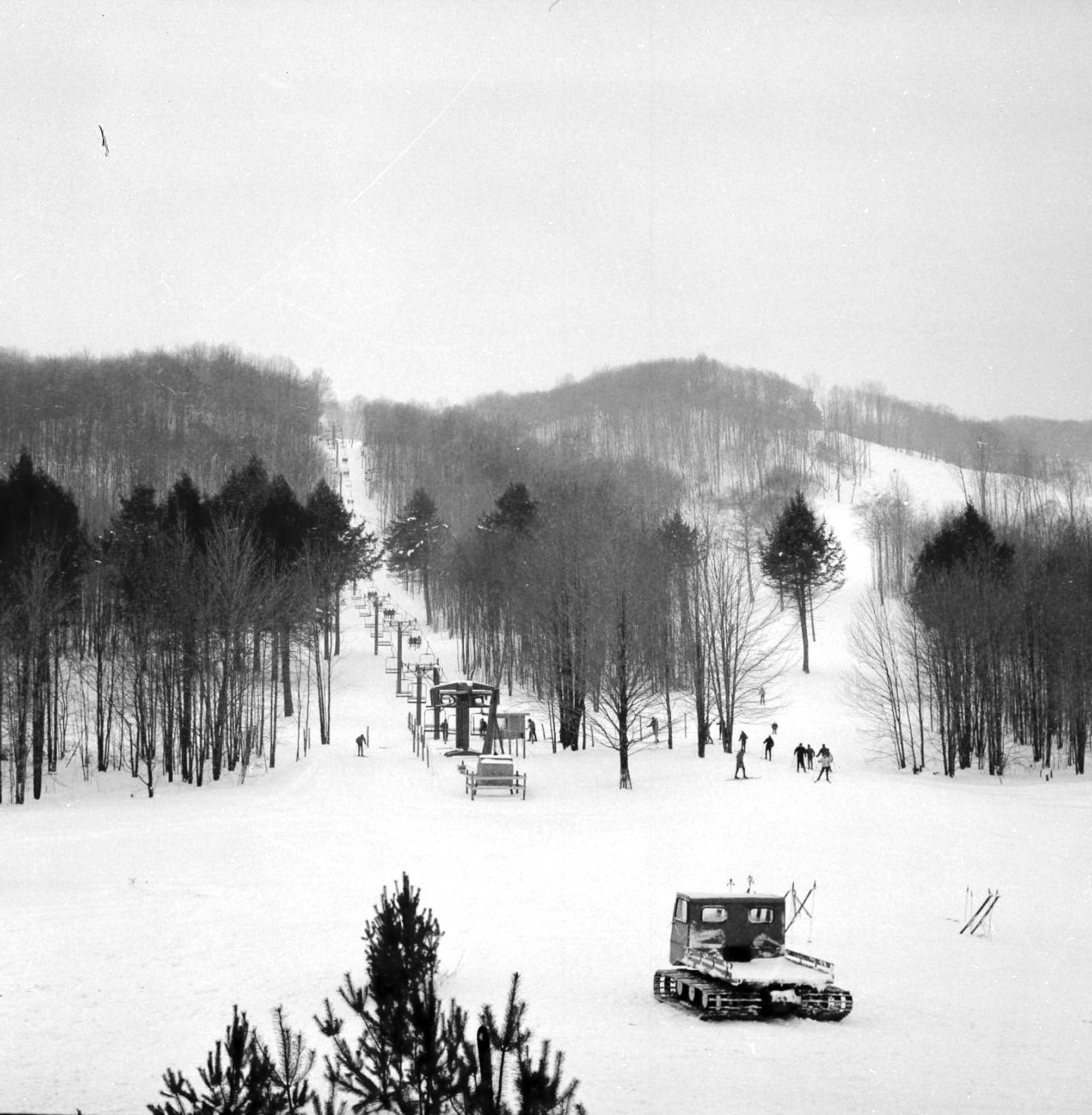
The early years of The Highlands. Photo courtesy of The Highlands and Greenwood Cemetery
Just days after the grand opening, the Press noted the “former Indian Gardens schoolhouse has been converted into a warming shack at the Harbor Highlands Ski Club and plans are being made for operation of a coffee and sandwich counter in the building. A large stove has been installed and restroom facilities are available in the former schoolhouse, Club President Tom Graham announced Thursday.”
The first few years of operation at Harbor Highlands were a challenge, but the owners seemed determined to make the ski area a success. A formal reorganization took place in 1958-1959 when 27 stockholders—led by local mink farmer O. Brager-Larsen. This group put up the capital for a $100,000 large-scale expansion with an addition of a 10-acre woodland slope and the widening of existing trails. A $19,500 Pomalift from France, with a capacity of 750 skiers per hour, was also installed.
Michigan remained #2 in the country (behind California) for the number of ski resorts and winter had become a dominate season for state’s tourism industry. During the 1957-58 season, skiers were expected to spend about $16.5 million, according to the Michigan Tourist Council.
Becoming a Part of the Boyne Family
Despite its best efforts, Harbor Highlands was struggling to survive, amassing considerable debt which forced its closure in the late 1950s. About this time, Everett Kircher began looking for ways to expand his Michigan footprint, and the defunct Harbor Highlands was on his radar.
“Mr. Brager-Larsen and his fellow stockholders quoted what I thought was a fair price and we closed the deal,” said Kircher in his biography. He not only acquired the ski operation, but he paid off the creditors and ensured the shareholders recovered their investment. But the former Harbor Highlands property wasn’t nearly big enough for Kircher’s vision, and he continued accumulating acreage.
“I’d learned the hard way that I’d better lock up all the adjoining land I wanted before I started to develop the facilities,” he continued, “otherwise, I’d be at the mercy of property owners—they would have smelled money, and the asking price would escalate about ten times the current value of the land.”
He soon had about 2,900 acres and was eyeing a key parcel near Frank Graham’s hobby farm. But the retired dentist didn’t need the money and had no interest in selling.
“I visited Dr. Graham, hoping to get him to change his mind about selling the acreage at the top side of the mountain range,” notes Kircher. “We had a number of friendly talks at his farm, and found we had a lot in common in our love of nature and history. He finally agreed to sell me the parcel…but there was a stipulation: to buy it I had to promise to build a sizable mound at the very top and name it Graham’s Peak.” Kircher readily agreed. In 1962, a wooden A-frame structure was also erected at the top of that peak, called Graham’s Chapel (which remains standing today).
Development of the rebranded and expanded Boyne Highlands began in May 1963. An article in the June 25, 1963, issue of the Petoskey News Review showed an aerial view of the future multi-million-dollar resort. Kircher planned to run both resorts as a package deal, with sleeping and eating facilities at each for skiers as tourists, as well as bus transportation between the two (30 miles apart). The entire project spanned eight years with a $10 million price tag ($1 million spent in the first year).
“The first two three-place chairlifts in the world will highlight facilities of Michigan’s newest ski resort, Boyne Highlands, scheduled to open between Harbor Springs and Petoskey, December 26,” according to the Petoskey News Review on August 14, 1963. Guided tours were offered to anyone interested in checking out the construction site of Michigan’s newest four-season resort.
The 410-foot “Old European High Country” lodge building was designed with 70 guest rooms—many with both interior and exterior access—to accommodate 200 guests. The lodge also offered a three-level cocktail lounge, three-level dining room with seating for 500, a cafeteria, equipment rental and service area.
“Boyne Highlands will open Thursday on schedule with the world’s first triple chairlifts in operation, 52 rooms full of guests, the slopes in excellent condition and the dining room and cocktail lounge operating,” wrote the Petoskey News Review on December 24, 1963. The resort opened with 11 trails, with a maximum vertical drop of 540 feet—the highest in the Lower Peninsula, and five lifts. The article noted that rooms at the new Highlands Inn had been sold out since October.
Always an innovator, in the 1970s Kircher developed and obtained patents for snowmaking technology to add to the natural accumulations that blanked his ski hills he named the Boyne Snowmaker (a.k.a. Highlands Snow Gun or Boyne Snow Machine). He also continued to improve on the lift systems which transported skiers to the tops of the slopes. In 1990, he had a high-speed four-place Heather Express installed—which could move 2,400 skiers per hour. Five years later, he expanded to the North Peak area with 12 additional runs and two more chairlifts.
In 2000, SKI Magazine recognized Kircher as one of the “Top 100 Most Influential Skiers of All Time,” ranking him alongside world-renown athletes like World Cup Champion and Olympic Gold Medalist Jean-Claude Killy and filmmakers like Warren Miller.
The Highlands Today
Today, The Highlands of Harbor boasts 435 skiable acres, 55 downhill runs (the longest being the 1.25-mile North Peak Pass), three terrain parks, eight chairlifts (including the high-speed Camelot 6—the Midwest’s first six-person high-speed Doppelmayr D-Line bubble chairlift, opened in December 2023), 35km of Nordic trails and 3.5km snowshoe trails. There are over 400 guest rooms without the condo-style hotel and the Scottish-themed Tudor-style inn.
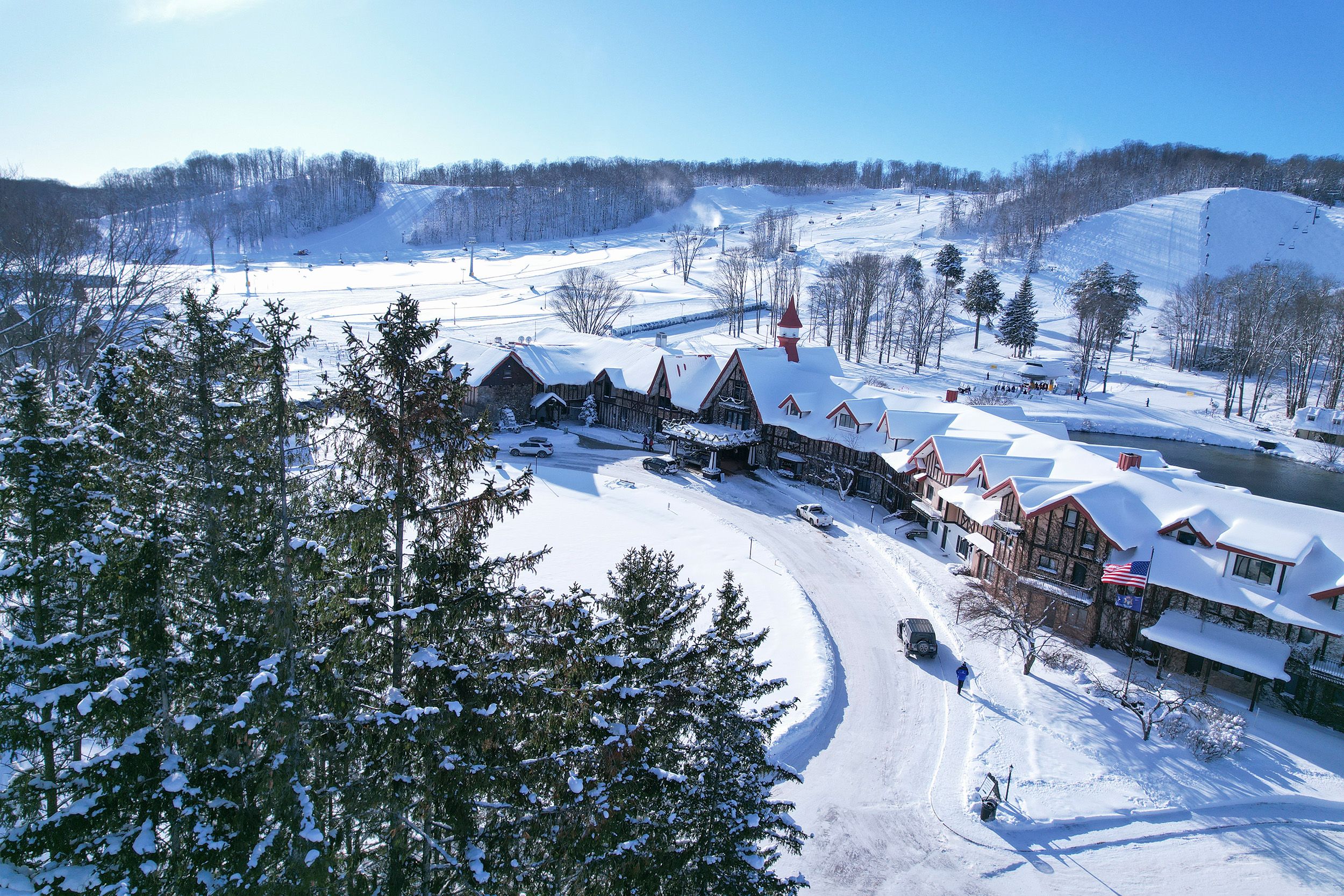
Photo courtesy of The Highlands Resort.
Nub’s Nob
Norman “Nubbie,” “Nubs” or “Nub” Sarns and his wife, Dorie, opened their first ski area on property near Cross Village and Good Hart, along the shores of Lake Michigan, in 1957. They quickly realized their proximity so close to the lake provided inconsistent lake-effect snowfall, so they moved further inland just a stone’s throw from Harbor Highlands on Pleasantview Road. Tree cutting and lift installation began in 1957 and to fund the project, they sold their race-winning sailboat, Symbol of Revelry.
Nub’s Nob formally opened on January 18, 1959, with three runs, a 65-seat chairlift, a rope tow, complete dining room facilities and rooms for 46 guests. At the time, it was the 24th ski resort in Michigan (and the sixth in the Petoskey region), which was seeing huge success for winter tourism.
In 1965, Dorie assumed ownership of the resort—a position she held until 1977 when she sold to brothers Walter and Alfred Fisher of the newly formed Pleasantview Ski Corp. Their father, Alfred Sr., was one of the seven founders of Fisher Body. Walter, Alfred Jr. and their brother, Bob, founded Fisher Corporation and General Safety, a Detroit-based company that manufactured seat belts for the automotive industry. It was through these successful businesses that they amassed the capital to invest in the ski resort.
Hemingway Connection
One of the first things the Fisher brothers did was hire Jim Dilworth as their resort general manager. He was the grandson of James S. “Uncle Jim” Dilworth, a Horton Bay blacksmith, inn owner and friend of Nobel and Pulitzer Prize-winning author Ernest Hemingway. As a side note, the elder Jim was the inspiration for a character in Hemingway’s Nick Adams story “Up in Michigan.”
The younger Dilworth worked at Boyne Highlands (now, The Highlands) from 1963 until 1977, specializing in the operation of chair lifts and artificial snowmaking, engineering high-efficiency ducted fan systems. He was co-inventor and patent holder for the “Highland” and “Nub’s Nob” machines (U.S. Patent Nos. 4105161 and 4573636), which could make quality snow at higher, borderline-freezing temperatures. These units were developed and manufactured by Snow Machines Inc., in Midland, Michigan. Dilworth’s design experience even landed him the honor as the official snowmaking consultant for the 1984 Winter Olympics in Sarajevo.
Recognitions and Today
From the onset, the Fisher family set a goal of being the best day ski area in the Midwest. Over the past three decades, Nub’s Nob has been recognized among the premier destinations in the United States by noted media such as Ski Magazine, Snow Country Magazine, Transworld Snowboarding, Outside Magazine, Detroit News and Oakland Press.
Today, Nub’s Nob remains in the Fisher family, led by owner and chairperson Elise Fisher (daughter of Walter Fisher), along with family members Greg and Yvonne Fisher. The resort operates 53 ski runs across three peaks (Front Side, South Side, and Pintail Peak) and two terrain parks, accessible via eight chairlifts, a rope tow and beginner conveyor/magic carpet, as well as 20.8km of groomed and tracked cross-country skiing trails and 2km of dedicated snowshoe trails.
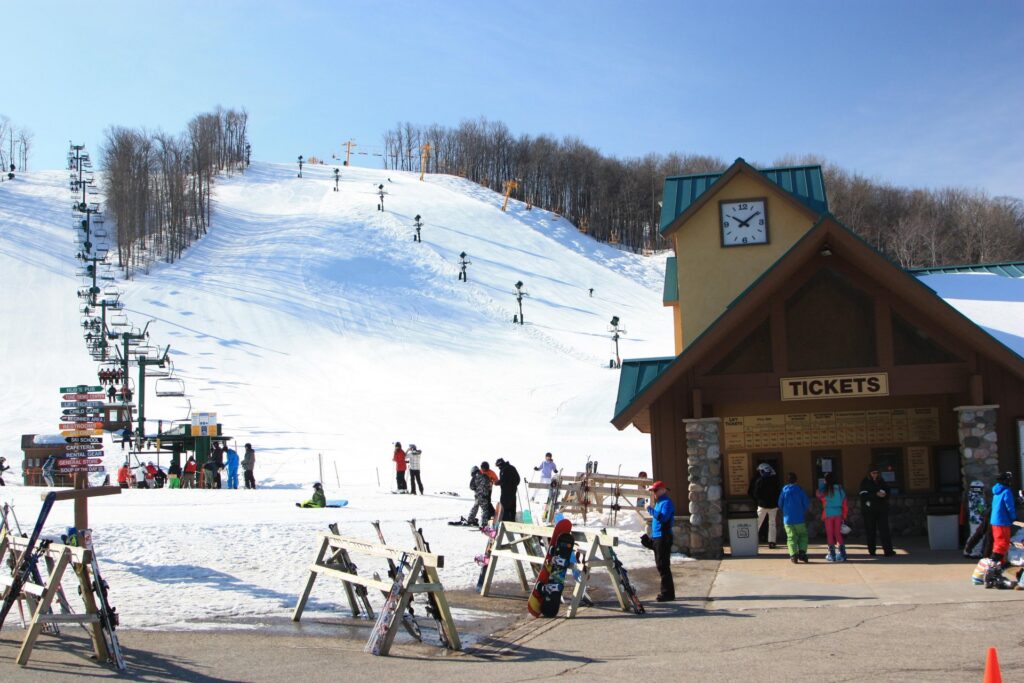
Photo credit: Petoskey Area Visitors Bureau
Challenge Mountain
In January 1957, three men from Walloon Lake—Cliff Gratsch, Gerald Fineout and Don Barrett—pooled together $60,000 and began developing the Walloon Hills Ski Area. The property featured three runs—a 3,600-foot advanced slope serviced by a French Pomalift (noted as the 91st in the country), a 3,300-foot intermediate slope and a 2,000-foot beginner’s hill, each with a tow rope. A 60 x 32 lodge, cafeteria and ski shop were also built on-site for the opening of the 1957-58 season.
“We are building this hill for the benefit of the motel, hotel and rooming house operators of Walloon Lake and Petoskey and are going all out to bring the finest hill in Northern Michigan to within 20 minutes of their doorstep,” Gratsch was quoted as saying in an August 7, 1957, article in the Petoskey News Review.
Al Pugel, former pro Avalanche Peak in Boyne City (today Avalanche Preserve Recreation Area), Boyne Mountain and in Sun Valley, Idaho, was hired to lead ski operations at Walloon Hills. Among the special services offered were afternoon “ladies’ day” each week as well as babysitting service at the lodge, so mothers could bring their children with them.
Walloon Hills was acquired by Boyne in the 1970s and in 1984 the property was donated to Challenge Mountain, a local non-profit providing adaptive recreation for individuals with disabilities. It remains in operation today.
DID YOU KNOW?
- Michigan still ranks #2 in the nation (behind New York) for the total number of ski areas with more than 40 (nearly 900 combined downhill runs), along with some of the best snow conditions and terrain in the Midwest.
- Three of the largest ski resorts in Michigan are found in the Petoskey area, including Boyne Mountain in Boyne Falls (#2 with 65 downhill runs), The Highland in Harbor Springs (#4 with 55 runs), and Nub’s Nob Ski Area in Harbor Springs (#5 with 53 runs).
- At one point, Everett Kircher and his Boyne operations owned almost every ski resort in the Petoskey area. In addition to Boyne Mountain and Boyne Highlands, he acquired Thunder Mountain near Boyne City in 1967 (shuttered in 1984), Walloon Hills in Walloon Lake in 1967, and Avalanche Peak (also known as Barn Mountain) in Boyne Falls in 1972 (which closed in 1968 after a fire, later donated to the city of Boyne City to be converted into Avalanche Preserve Recreation Area).
- The Petoskey area receives about 140 inches of snow, on average, each year. There have been some exceptional years:
- 1985: 231.1 inches
- 2014: 194.5 inches
- 1989: 186.6 inches
- In terms of winter seasons in Petoskey, the last dozen years have provided significant accumulation, including:
- 2013-2014: 220 inches
- 2025-2026: 187 inches
- 2024-2025: 169 inches
- The single-day snowfall record in Petoskey was 24 inches on December 26, 2001.
 About the author: Dianna Stampfler is the president of Promote Michigan, founded in 2024. She has been researching the state’s historic lighthouses for more than 25 years and is the author of the best-selling books “Michigan’s Haunted Lighthouses” and “Death & Lighthouses on the Great Lakes.”