
A Northern Michigan Guide to Viewing the Perseid Meteor Shower
August 5, 2026
Coming soon: The Perseid Meteor Shower is set to light up your summer nights. The shooting stars that characterize this annual celestial event are already traversing our skies, lasting from July 17 to August 24 this year.
In 2026, the Perseids peak on August 12-13, when intrepid observers will be able to see over 50 meteors per hour.
But that doesn’t mean you have to wait! And don’t worry too much about missing it all due to a cloudy night during peak viewing. This is one of those astronomical slow burns. Even if you don’t catch the absolute pinnacle of Perseid visibility, you can still catch a glimpse of meteors on a night without cloud cover.
Keep reading for more details on how these meteors happen to cross our nighttime skies each summer, and where you can get a front-row seat to the dazzling light show.
Where do Perseid meteors come from?
First things first: What are the Perseids? And how can astronomers accurately predict when they’ll be visible in the night sky?
First, the Perseids (pronounced Pur-see-edz) are an annual event that people across the Northern Hemisphere look forward to. After all, fireballs across the night sky are a big deal, right?
According to NASA, these meteors are flaming bits of debris left over from Comet Swift-Tuttle. With any icy, dust-filled heart that’s roughly 16 miles wide, Swift-Tuttle is estimated to be twice as large as the asteroid that ended the reign of the dinosaurs. It takes 133 years to orbit the Sun once, and it won’t be back in our neighborhood until around 2126.
When comets approach the sun, parts of their frozen cores vaporize, releasing a trail of dust we think of as the comet’s tail. Every summer, we pass through Swift-Tuttle’s debris field leftover from its close encounter with our favorite star.
As those particles come in contact with our atmosphere, they burn up and produce the brilliant, flaming meteors we love to watch each summer.
Just a note on terminology: Meteoroids are space rocks. Meteors are space rocks that flame up when they reach our atmosphere, like the Perseids. And meteorites are space rocks that have actually made contact with Earth’s surface.
It’s hard to say how long the Perseids have been around, but sightings of the flashing meteors may have been recorded as early as 322 B.C.E.
Two astronomers, Lewis Swift and Horace Tuttle, witnessed the comet that bears their name streaking across the sky in 1862. A few years later, in 1865, Giovanni Schiaparelli realized the trailing tail of Comet Swift-Tuttle was the source of the Perseids.
Surprisingly, the Perseid meteor showers don’t have any specific mythology surrounding them, in spite of their beauty. However, to viewers on the ground, they appear to originate within the constellation Perseus—the mythological son of Zeus and monster slayer—hence the name.
Those fireballs you see streaking across the sky in the summer months are traveling at a mind-bending 25,000 to 160,000 mph before they burn up in Earth’s atmosphere. Scientists estimate that almost 49 tons of meteoric debris falls on our planet each day, but we’re fortunate that friction between meteoroids and the air usually causes them to vaporize, producing a light show.
Where to see the Perseids in northern Michigan
This year, the Perseids’ peak will occur during the new moon, meaning maximum meteor visibility.
“If the weather cooperates, it should be a phenomenal year for the meteor shower,” according to Jamie Westfall, the Emmet County Park Manager who oversees Headlands International Dark Sky Park near Mackinaw City.
We’ve featured the Headlands previously in the Visitors Center blog because the park and its astronomers offer a version of the night sky that few get to see in modern times. Light pollution can interfere with stunning views of the Milky Way and glorious constellations our ancestors witnessed on a regular basis. But at the Headlands, staff take extra care to expose patrons to dark skies that reveal celestial splendors, like dozens of sparkling meteors per hour, right from the shores of Lake Michigan.
A visit to Headlands can turn stargazing into a memorable occasion. Aside from spectacular night sky viewing, the park maintains a visitor center, plentiful programs with on-site astronomers and a gift shop. Its proximity to Wilderness State Park and Mackinaw City means it draws in visitors from close to home and around the globe.
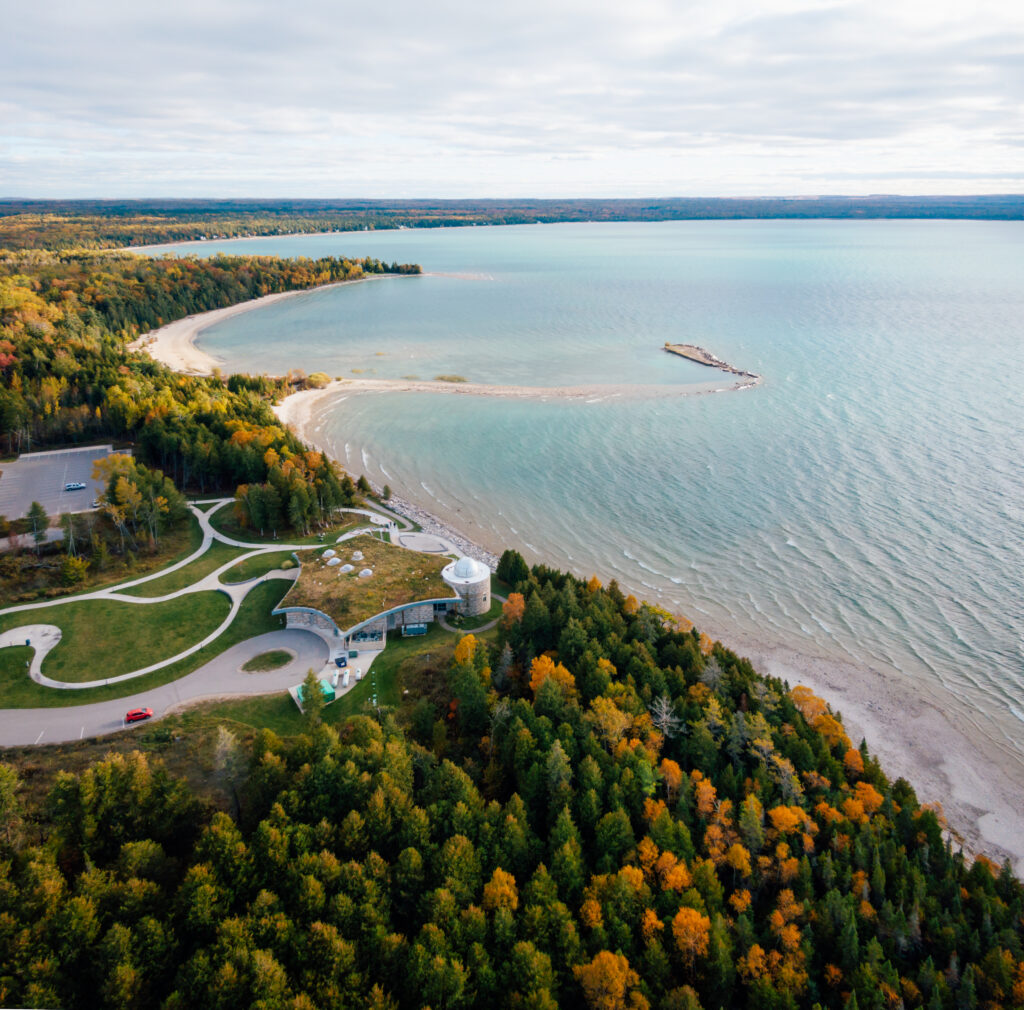
Headlands International Dark Sky Park provides a waterfront view of the Milky Way, plus plenty of scenic trails and educational opportunities provided by park astronomers. Photo credit: Headlands International Dark Sky Park
“The Perseids are a great opportunity to get people out to the park, some of them often for the first time. Some have never seen the Milky Way. At the Headlands, they can have this experience in a relatively safe space in the company of others,” Westfall said.
In 2026, the Perseids coincide with the Headlands’ annual Lights Out Challenge on August 12, encouraging northern Michigan residents to turn out all their lights between 10:30 and 11:30 p.m. Darker skies will equal more visible meteors and help staff meet their goal of measuring the darkest skies ever recorded in the park. The Headlands will host a free program on the effects of light pollution the same day at 8:00 p.m.
For more info on optimizing your astronomical encounters, Westfall suggests that readers head to Dark Sky International and learn how to improve stargazing experiences and find dark sky parks and communities all over the world.
Even if you can’t make it to the beach to watch a gorgeous light show in the presence of other rapt stargazers, Westfall said if you can get away from brightly lit downtown areas you should be able to catch a glimpse of the meteors flaming out in our atmosphere.
If you can get to the Headlands for the main event, we’ve compiled a guide for making the most of your experience, below.
Know before you go
First-time visitors to the Headlands without a solid plan can end up disappointed. Park staff made the following suggestions to optimize your time at this premier dark sky park.
- Check the weather. One of the most common mistakes is coming out to see the stars on a cloudy night.
- It can be chilly at night, so bring an extra warm layer or blankets.
- For outdoor viewings, such as meteor showers, bring something to sit on.
- The trails, viewing areas, and restrooms are open 24/7. Facilities are only open to the public during programs or by private rental.
- Arrive early for programs. The parking lot is relatively small, and the line to enter the park can be long. There is overflow parking across the street at Heritage Village, and guests can enter on foot.
- Park with your headlights facing away from the shoreline and viewing areas.
- Bring a red-filtered flashlight for navigation around the park. White light can obscure the view of the night sky. You can cover a regular flashlight with red plastic wrap for a DIY red filter. Appropriate flashlights may be available at the gift shop.
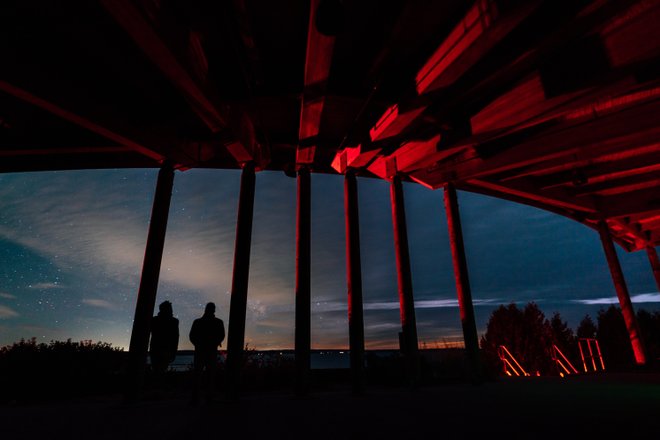
Only red lights are allowed at night at Headlands’ facilities, which include the visitors center and gift shop. Red Lights don’t alter night vision and allow visitors a better experience during astronomical events. Photo credit: Headlands International Dark Sky Park
 About the Author: Jen DeMoss is a newcomer to the Petoskey area and loves northern Michigan. You can catch her paddling a canoe, hiking a trail, or swimming in Lake Michigan as often as the weather cooperates. She’d love to help you make the most of your time in this paradise she now calls home.